


Elon Musk America’s AI Debt Crisis
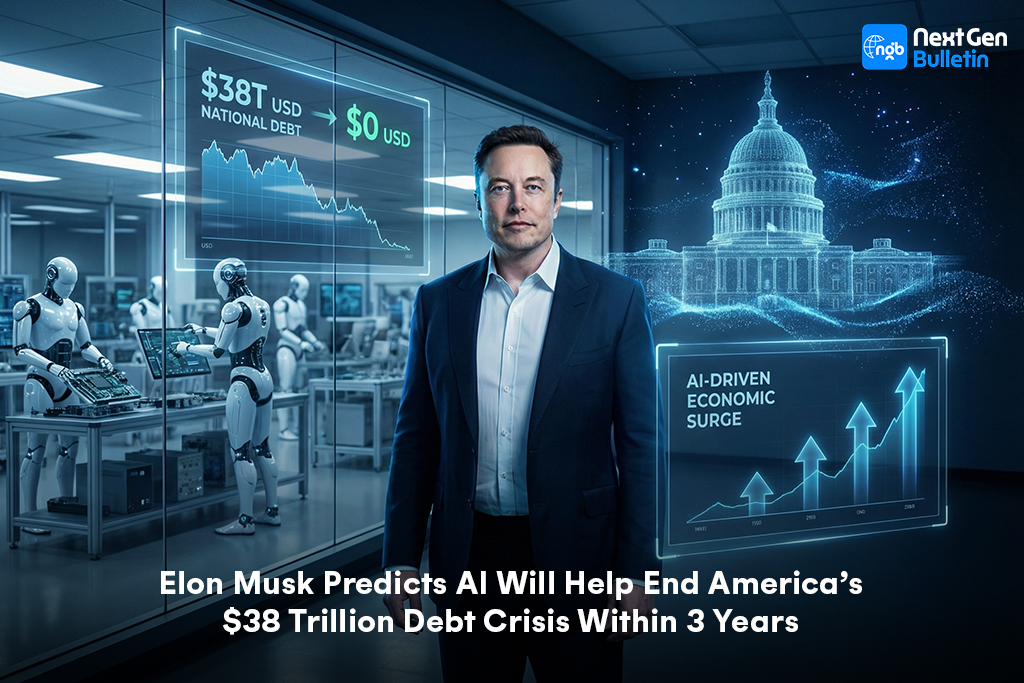
America’s $38T Debt continues to grow at an alarming pace, with the United States now carrying roughly $38.34 trillion in national liabilities — a level many experts view as unsustainable for the future. In a recent statement, tech entrepreneur Elon Musk asserted that the only realistic solution to prevent an economic collapse is the rapid expansion of AI and robotics across the U.S. economy.
Musk warned that traditional political measures and fiscal reforms are no longer enough. Instead, he believes that only a surge in productivity driven by artificial intelligence and robotics can generate the economic output required to offset the mounting debt obligations.
AI Solves US Debt Crisis: The Proposal
According to Musk, combining advanced AI systems with robotics (like his company’s humanoid project) could dramatically accelerate production and services — a potential solution for America’s $38T Debt.
He envisions a future where automation ensures surplus production of goods and services, lowering costs, creating abundance, and possibly rendering traditional currency less relevant. This AI-powered shift could help reduce America’s $38T Debt by driving unprecedented economic efficiency.
In Musk’s scenario, AI-driven production could outpace inflation, enabling “economic deflation via AI” and making basic goods cheaper while increasing societal wealth — a model that supporters call a possible path to eliminating America’s $38T Debt.
Robotics, Economic Productivity & The Role of Tech
Central to Musk’s argument is the role of robotics and advanced AI systems driving productivity at an unimaginable scale. By automating labor-intensive tasks across manufacturing, agriculture, and logistics, robotics could significantly contribute to solving America’s $38T Debt.
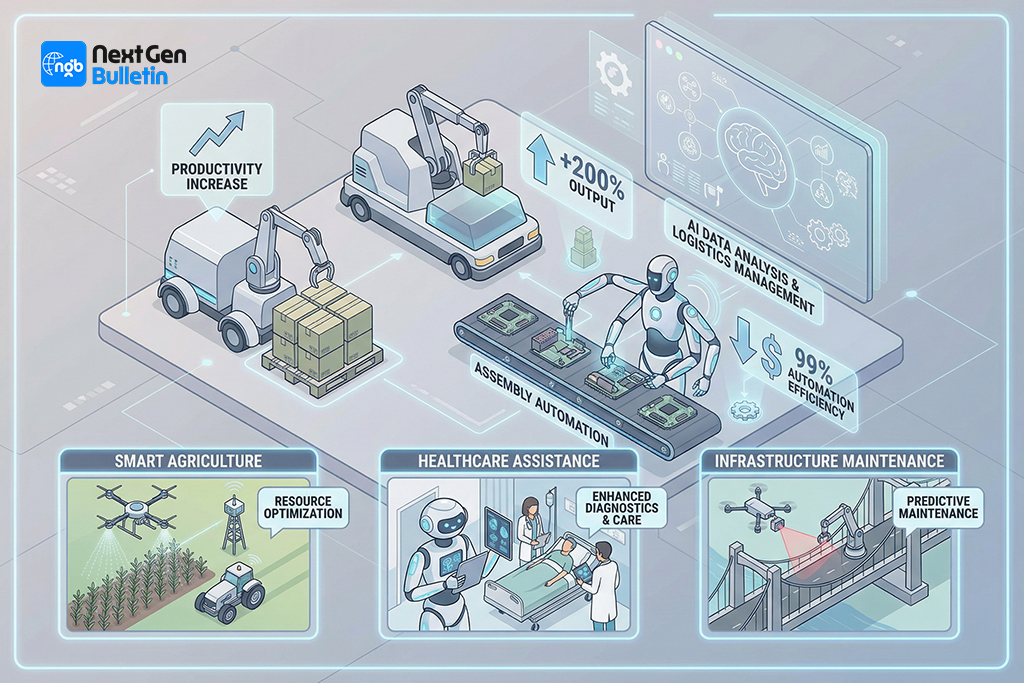
If robots and AI tools sustain high speed, precision, and 24/7 output, economic productivity could potentially surge, lifting output levels far above current norms and helping manage America’s $38T Debt through more sustainable debt servicing and public expenditures.
As goods become cheaper and production scales increase, the cost barriers for consumers and the overall burden of fiscal debt may reduce significantly. This shift could directly ease America’s $38T Debt by improving efficiency across manufacturing, services, healthcare, infrastructure, and public utilities.
Economic Deflation via AI & Debt-Free America Prediction
Musk bases his optimism on a phenomenon he calls economic deflation via AI, where rapid automation and efficiency gains bring down production costs, driving down prices for consumers while expanding output. If implemented at scale, this could reduce inflationary pressures and raise real incomes, enabling economic growth without proportional spending increases.
He goes further: in such a future, traditional work could become optional, and money (as a medium) might lose importance. Resources such as energy and materials would remain limiting factors, but AI-driven abundance could reshape societal structures around equity, wealth distribution, and resource access.
Musk’s prediction: with AI and robotics, America could navigate out of its $38 trillion debt crisis within three years, provided policies, implementation, and technological scaling align.
But There Are Warnings: Risks & Skepticism
Not everyone agrees with Musk’s optimistic forecast. Many economists and AI experts warn of serious transition costs. Massive automation could lead to widespread job displacement, inequality, and social upheaval. Productivity increases may not evenly translate to widespread benefit.
Moreover, reliance on AI and robotics depends on stable infrastructure, energy supply, and resource distribution, all of which could strain under increased demand. Musk himself has admitted the path will involve “trauma and disruption.”
Critics also question whether productivity gains alone can reduce structural debt, or if systemic reforms (taxation, social spending, regulatory changes) remain necessary. Eliminating debt without addressing root fiscal imbalances might only postpone the crisis.
What to Watch: Key Variables for Musk’s Vision
| Variable | Why It Matters |
| Speed of AI / Robotics Adoption | Faster deployment increases output and economic growth. |
| Energy & Infrastructure Capacity | AI productivity growth demands stable power and resources. |
| Government Policy & Regulation | Tax, regulation, and welfare policies will shape the distribution of gains. |
| Social Safety Nets & Equity Measures | To manage potential job losses and wealth concentration. |
| Global Economic Stability | Inflation, trade relations, and global demand influence overall success. |
If these variables align and technological adoption is rapid, Musk argues AI could indeed shift America’s economic trajectory.
Bottom Line
Elon Musk’s bold prediction that AI and robotics could eradicate America’s $38T debt crisis within three years has sparked optimism, debate, and concern. While AI-driven productivity and automation offer a potential path to economic transformation, even “debt-free America”, success depends on scaling technology, stable infrastructure, and equitable policy.
For ongoing analysis on AI’s impact on economies and society, watch developments by visiting our homepage.