
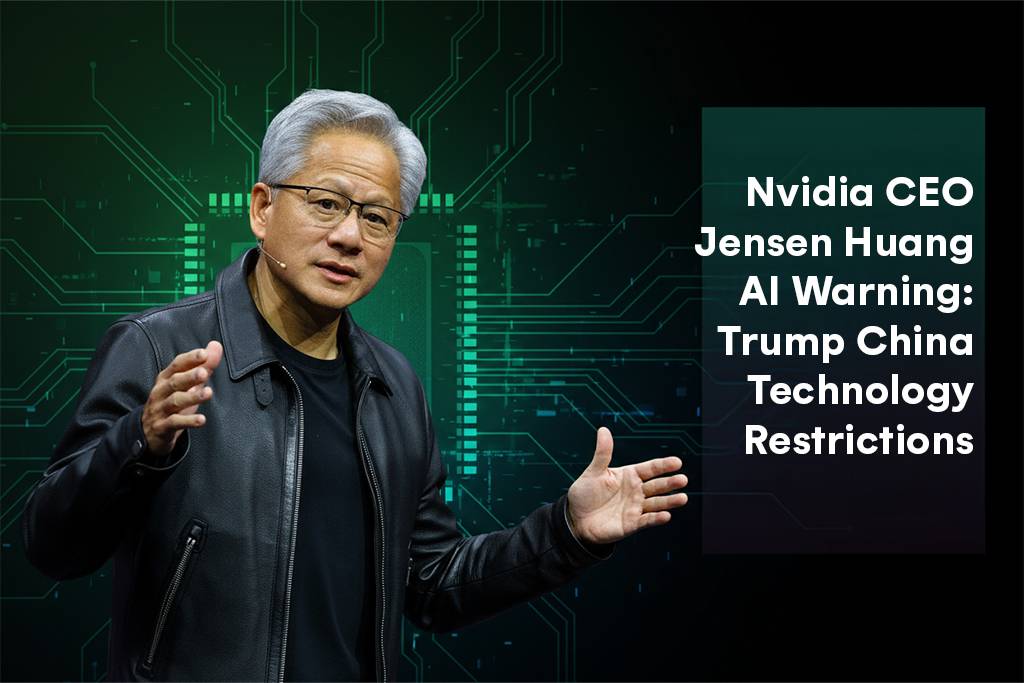

Jensen Huang, chief executive of Nvidia, has sounded a striking alarm over the global artificial-intelligence race, suggesting that China may be poised to outpace the United States, as American export restrictions led by Donald Trump attempt to curb China’s access to advanced AI chips.
Huang emphasized that China benefits from lower energy costs, strong government backing, and a surging base of AI researchers, factors that could allow it to close the gap with the U.S. more quickly than many believe. At the same time, the U.S. government’s tightening of chip-export and technology-transfer rules risks sidelining American firms from key global developer communities.
Nvidia AI Chip Demand China Deal
While Nvidia remains a dominant force in AI hardware, its access to the Chinese market is increasingly constrained. The company’s advanced AI chips designed to power large language models and generative AI are largely barred from sale in China under U.S. export controls. Huang confirmed that there are currently no active discussions about selling Nvidia’s flagship “Blackwell” chips to China.
At the same time, Chinese state-driven data-centre projects are ramping up, and although Nvidia has reported strong global orders, the absence from China could restrict the company’s long-term demand growth in the world’s biggest AI market.
Nvidia China-Specific AI Chips & China’s Local Chip Directive
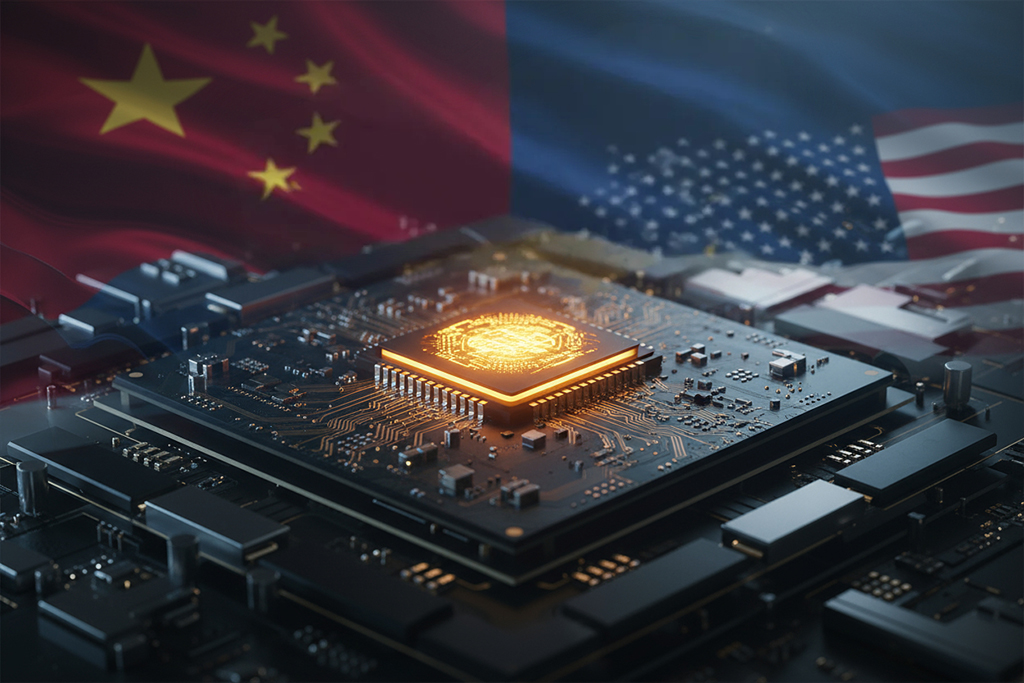
China has taken explicit steps to reduce its reliance on foreign AI chip makers like Nvidia, issuing guidance that state-funded AI data-centres must use domestic chips rather than American products.
Huang acknowledged the strategic risk: he said that when a country closes its market to Nvidia systems, it must carefully consider what might harm China could also harm America’s technological lead.
This shift threatens Nvidia’s business in China and highlights the significance of China’s push to develop its own AI-hardware ecosystem.
Trump China Technology Restrictions & Global Impact
The U.S. has ramped up restrictions under the Trump administration on exporting top-tier AI chips and related technologies to China. Huang described these controls as counterproductive, arguing that they have instead spurred a more determined Chinese tech industry.
He warned that by cutting off China’s access to American chips and developers, the U.S. may inadvertently hand strategic advantage to its competitor, reversing the goal of preserving leadership in AI. Huang stressed that gaining market access to China’s huge developer base is crucial for global influence in AI infrastructure.
The Bottom Line
Nvidia’s CEO’s stark message comes at a pivotal moment for global AI leadership. China, with its government support, lower energy costs, and massive talent pool, appears more capable than ever of catching up. Meanwhile, export-control policies and market access restrictions risk isolating American chip-makers from the world’s largest AI development ecosystem.
For Nvidia, the challenge is not only to innovate faster but to navigate geopolitics. For global AI competition, the race is no longer just about who builds the fastest model, it’s about who controls the hardware, supply chains, and access to talent.
Frequently Asked Questions (FAQ)
1. Why is Nvidia’s CEO Jensen Huang warning about AI competition with China?
Jensen Huang believes that U.S. export restrictions on advanced AI chips could slow down American innovation while motivating China to accelerate its own AI development. He warns that cutting off China might hurt U.S. influence in the global AI ecosystem.
2. How are Trump’s technology restrictions affecting Nvidia?
The export bans prevent Nvidia from selling its most powerful AI chips to China, limiting access to one of the largest AI markets in the world. While Nvidia remains strong globally, its growth in China is now heavily constrained.
3. What is China doing in response to U.S. chip restrictions?
China has launched a national effort to build its own AI chip industry. Government-backed projects and incentives are pushing local companies to develop homegrown alternatives to Nvidia’s hardware, reducing dependency on U.S. suppliers.
4. What are Nvidia’s options in the face of these restrictions?
Nvidia is focusing on innovation and diversifying its customer base outside China. It’s also exploring region-specific chip models that comply with export rules while maintaining performance for global markets.
5. How could these restrictions impact global AI leadership?
According to Huang, isolating China could weaken America’s long-term influence in AI research and infrastructure. Instead of slowing China down, the restrictions may strengthen its resolve to lead independently in AI technology.
6. Is China catching up to the U.S. in AI development?
Yes, and faster than many expect. With strong government support, lower operational costs, and a growing pool of AI talent, China is rapidly closing the gap in both research and hardware capabilities.
7. What does this mean for the future of AI innovation?
The global AI race is shifting from pure innovation to geopolitical strategy. The real contest lies in who can control hardware supply chains, access to data, and global developer networks — not just who builds the smartest models.