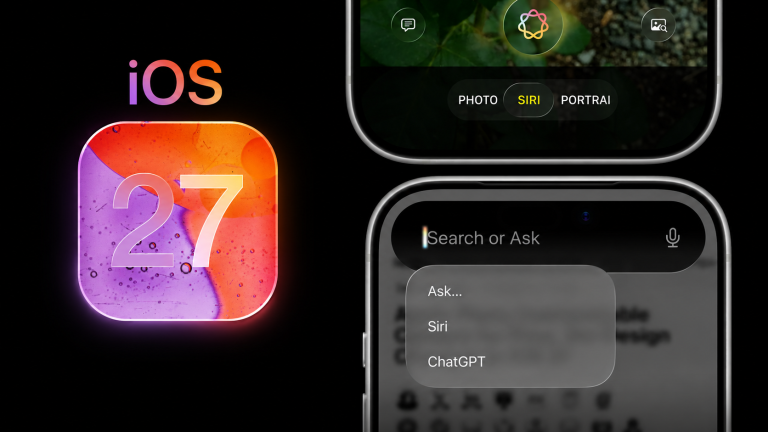
Apple is gearing up for one of its most ambitious iPhone software overhauls in years. Leaked illustrations and insider reports reveal iOS 27 will bring a completely redesigned Siri powered by advanced AI, a new Dynamic Island interface, support for ChatGPT, Gemini, and Claude, plus a pro-level Camera app and powerful AI photo editing tools. …
Apple is preparing what could be its most transformative iPhone software update in over a decade. With WWDC 2026 scheduled to kick off on June 8, leaked illustrations and detailed insider reports have pulled back the curtain on iOS 27 — a sweeping update that reimagines Siri from the ground up, integrates third-party AI assistants like ChatGPT and Google Gemini, and delivers a slew of camera and photo-editing upgrades powered by Apple Intelligence. Here is everything we know so far about the iOS 27 release and what it means for iPhone users worldwide.
A New Era for Siri: From Voice Assistant to AI Powerhouse
For years, Siri has struggled to keep pace with the rapid advances of conversational AI. That narrative is about to change significantly. According to leaked Bloomberg illustrations based on internal Apple sources, iOS 27 will introduce a completely rebuilt Siri experience — one that positions Apple’s voice assistant as a genuine AI companion rather than a glorified shortcut launcher.
The revamped Siri will no longer exist as a separate overlay that interrupts your workflow. Instead, it will be deeply woven into the system, living persistently inside the Dynamic Island at the top of the iPhone screen. This means Siri will be available at a glance, without the need to pause whatever task you are in the middle of. The shift is both visual and functional — a fundamental rethinking of how Apple Intelligence should feel on a device people use every day.
Siri Moves Into the Dynamic Island
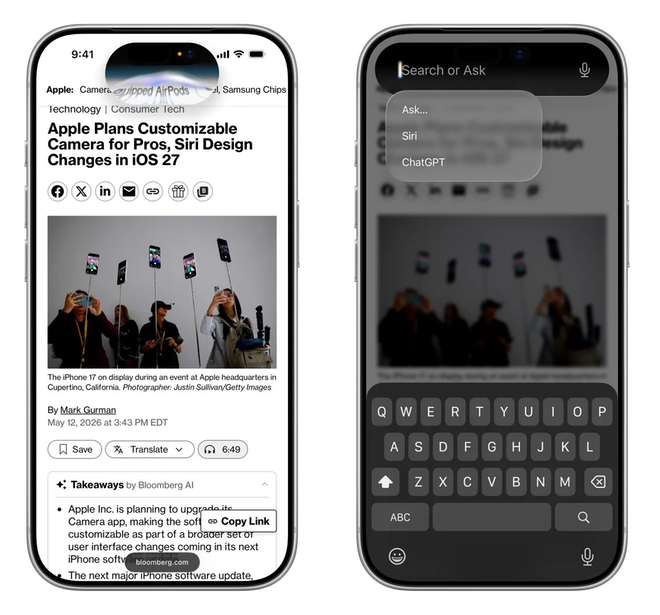
According to reports, there will be two distinct ways to wake Siri on iOS 27. The first remains familiar: saying “Siri” out loud or pressing the side button. This method will trigger a Siri animation directly within the Dynamic Island, making it ideal for quick voice queries on the go. The Dynamic Island — the pill-shaped cutout found on iPhone 14 Pro, 15, 16, and 17 models — becomes Siri’s permanent home base in the new design.
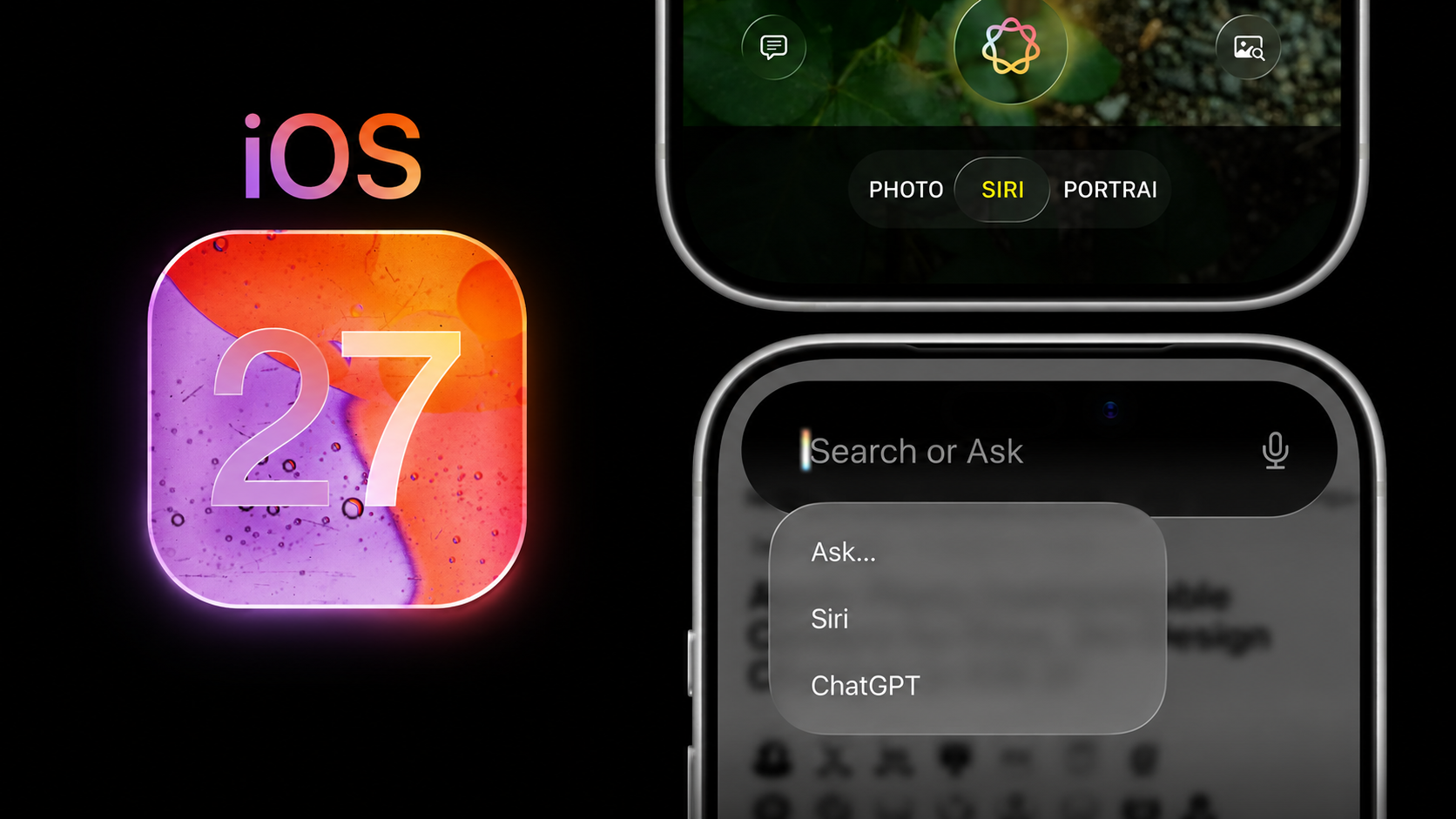
The second method is entirely new and arguably more exciting. By swiping down from the top center of the screen, users will access a “Search or Ask” interface — a unified hub that combines system-wide search, Siri Suggestions, and AI-powered queries into one destination. Results from this interface will appear as rich text cards that expand outward from the Dynamic Island itself, creating a seamless, polished experience that feels truly native to the iPhone hardware.
The “Search or Ask” Interface: Your AI Hub on iPhone
The new Search or Ask screen is designed to be a true command center for iPhone users. From this single interface, users will reportedly be able to search through notes, emails, messages, and calendars; launch shortcuts; create appointments; send texts; and search the web — all without ever leaving the interface. It is a vision of a frictionless, context-aware assistant that understands your data and your intentions at the same time.
Results will appear as rich information cards that are visually connected to the Dynamic Island, making the experience feel cohesive and deeply integrated. The design is said to remain dark regardless of whether the iPhone is using Light or Dark Mode, giving it a consistent, premium look. Siri Suggestions — currently showing your eight most-used apps — will also be incorporated into this new interface.
Third-Party AI Integration: Siri Opens the Door to ChatGPT, Gemini, and Claude
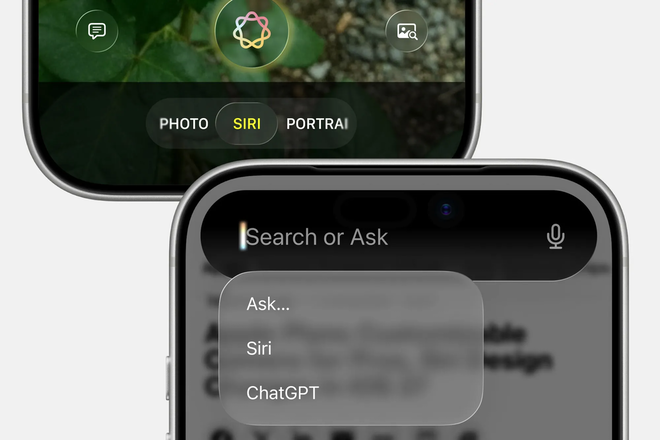
One of the most consequential reported changes in iOS 27 is that Siri will no longer operate as a closed ecosystem. Apple is said to be testing a system that lets users route their queries directly to third-party AI services from within the Search or Ask interface. A dropdown menu will reportedly allow users to choose between Siri, ChatGPT, Google Gemini, and Anthropic’s Claude.
Apple already has an existing partnership with OpenAI for ChatGPT integration, which was introduced in iOS 18. But the extension of this model to Google Gemini and Claude represents a significant philosophical shift. Rather than trying to be the only AI on the device, Apple appears to be positioning Siri as an intelligent router — a hub that connects users to whichever AI tool is best suited for their query. This approach also makes practical sense from a technical perspective: complex queries can be offloaded to external models while simpler ones are handled on-device to preserve privacy.
On-Device vs. Cloud AI: The Privacy Balance
Privacy has always been a core pillar of Apple’s brand identity, and iOS 27 appears to maintain that commitment while still expanding AI capabilities significantly. Reports indicate that Apple will use WWDC 2026 to demonstrate how many AI queries can be processed entirely on-device, powered by the neural engine chips inside iPhones, Macs, and Apple Watches. This means sensitive personal data — messages, emails, appointments — can be analyzed without leaving the device.
For more computationally demanding queries, however, Apple is said to be leveraging Google’s Gemini to power a smaller AI model trained specifically to run on Apple hardware. This hybrid approach allows Apple to offer cutting-edge AI performance while keeping infrastructure costs manageable and positioning itself as a privacy-first company in an increasingly AI-driven market.
The Dedicated Siri App: Conversations, History, and File Analysis
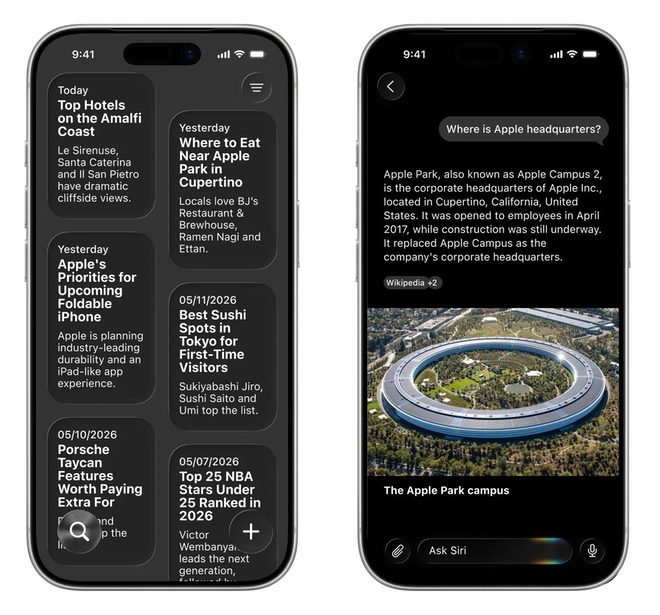
Beyond the Dynamic Island integration, iOS 27 is expected to introduce a standalone Siri app that looks and functions far more like ChatGPT or Google Gemini than the Siri users know today. The home screen of this dedicated app will display a full conversation history, allowing users to pick up where they left off across multiple sessions — a feature that has long been absent from Siri and that power users have craved.
Within the Siri app, users will be able to communicate via text or voice, upload photos and documents for analysis, and receive responses that pull from both the web and personal device data simultaneously. Siri will be capable of generating rich cards for news updates, weather forecasts, sports scores, and calendar information, weaving together information from multiple sources into a single, coherent response. It will also be able to draft emails and text messages using information it gathers from the internet and from the device, and can check the user’s calendar to flag availability or scheduling conflicts.
Agentic Siri: The Assistant That Actually Does Things
Perhaps the most significant shift is the transition from a reactive to a proactive, agentic AI model. The new Siri will not just answer questions — it will take actions across the operating system and within apps on the user’s behalf, without requiring step-by-step guidance. This is precisely what Apple teased back at WWDC 2024 but has been slow to fully deliver. iOS 27 appears to be the version where that vision becomes a reality.
Alongside the Bloomberg reports, a separate development has reinforced this trajectory: Apple quietly previewed a new Voice Control feature ahead of WWDC, powered by Apple Intelligence. Instead of relying on rigid commands, this feature allows users to speak naturally to control their iPhone — for example, saying “Tap the orange folder” or “Open this file and zoom in.” This accessibility feature is widely viewed as an early glimpse of the broader agentic Siri architecture coming in iOS 27.
Pro Camera App and AI-Powered Photography Tools
The camera system is getting a major overhaul in iOS 27, and it extends well beyond just adding new shooting modes. Apple is said to be redesigning the Camera interface with advanced customizable controls, making the app significantly more appealing to professional photographers and serious enthusiasts who have long felt that the iPhone camera app lacks the granular control available on competing platforms.
Siri Integration Directly in the Camera
One of the most practical additions is Siri’s integration directly within the Camera app. Users will reportedly be able to photograph an object and send it directly to an AI system for analysis, or trigger a reverse-image search — functionality similar to what Google Lens has offered for years on Android devices. This brings the intelligence of Siri into the moment of capture, not just after the fact in the Photos app.
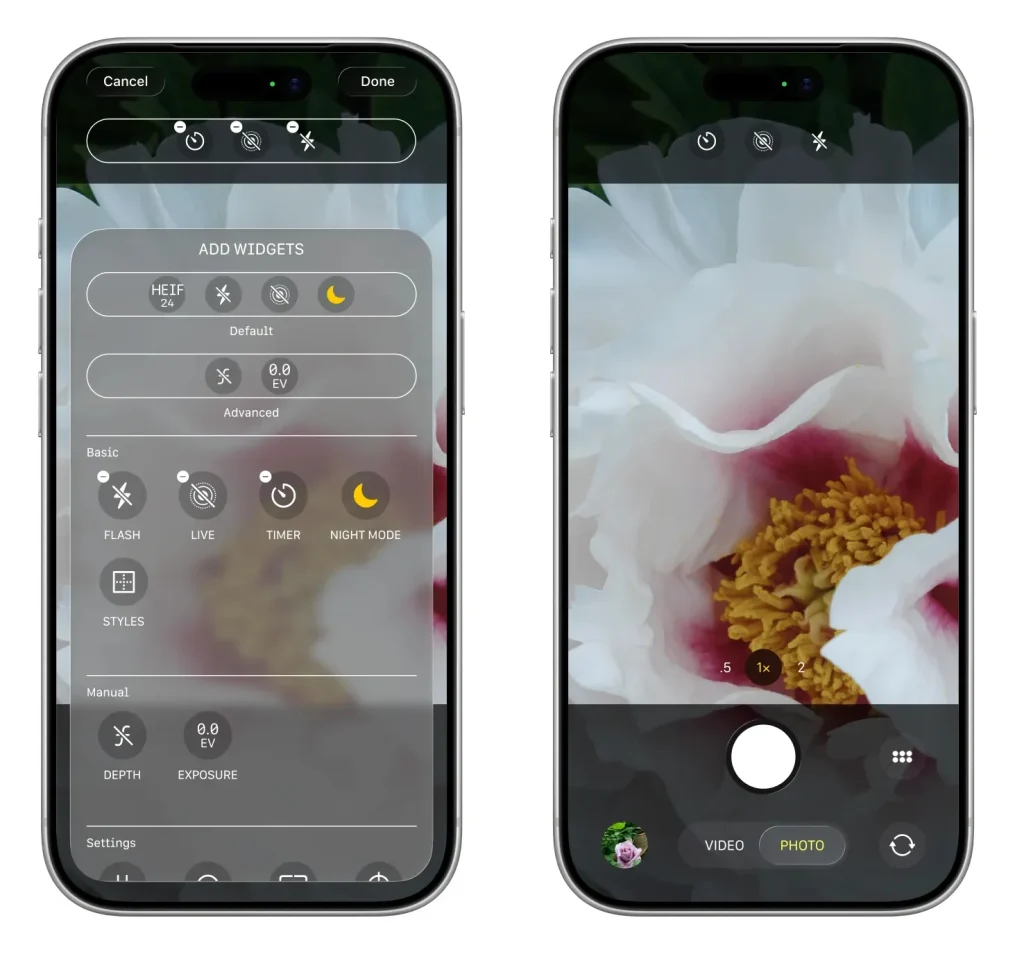
Camera controls are also being redesigned to be more customizable. Users will reportedly be able to add and remove widgets within the camera interface, choosing which tools — such as exposure, depth, timer, flash, and night mode — appear front and center. This is a meaningful upgrade for users who have always wanted their camera app to behave more like a professional tool rather than a simplified consumer interface.
AI Photo Editing: Extend, Enhance, and Reframe
The Photos app is also receiving a significant AI-powered boost with new editing capabilities that put it closer to competing with tools available on Google Pixel and Samsung Galaxy devices. Joining the existing Clean Up feature will be three powerful new AI tools: Extend, Enhance, and Reframe. These features will allow users to alter the composition of an image, generate missing portions of a photo to fill out a wider frame, and intelligently enhance overall image quality using Apple Intelligence models.
Apple is also said to be testing natural-language photo editing commands — meaning users could theoretically say “Make this photo look like it was taken at sunset” or “Remove the person on the left” and have Siri carry out the edit directly. This level of AI-driven editing would represent a substantial leap forward for Apple’s photography ecosystem.
Smarter Shortcuts, AirPlay Updates, and AirPods Improvements
The Shortcuts app, which has historically required technical know-how to use effectively, is reportedly getting one of its most practical upgrades in years. Instead of manually building automation workflows, users will simply be able to describe in plain language what they want to happen. Siri will then construct the automation on their behalf. As an example, a user might say: “When I start driving home, play my road trip playlist and send my family an ETA.” Siri would handle the rest.
Beyond Siri and the camera, iOS 27 is also bringing notable changes to AirPlay compatibility. In response to the EU’s Digital Markets Act, Apple is said to be introducing support for alternate protocols such as Google Cast, enabling users to share content to a wider range of non-Apple devices. AirPods settings are also getting a redesign, with a more intuitive control panel for managing noise cancellation levels, switching between connected devices, and customizing touch controls.
What Devices Will Support iOS 27?
While Apple has not yet officially confirmed the device compatibility list for iOS 27, the Dynamic Island-based Siri interface is expected to be exclusive to iPhone models that feature the hardware — namely iPhone 14 Pro, and all models of the iPhone 15, 16, and 17 series. Full Apple Intelligence features, including the most advanced Siri capabilities, will likely continue to require an iPhone 15 Pro or later with the A17 Pro chip or newer.
Older devices running iOS 27 may still receive the software update but could be limited to a subset of the new AI features. Apple is expected to confirm exact compatibility details at WWDC 2026, with developer betas following shortly after and a public release expected in September 2026.
iOS 27 vs. Android: Closing the AI Gap
For the better part of two years, Android manufacturers — particularly Google with Pixel and Samsung with its Galaxy line — have been setting the pace in mobile AI. Google’s Gemini Live, circle to search, and AI-powered photo editing have given Android users features that iPhone owners could only envy. Samsung’s Voice Access and Galaxy AI suite similarly raised expectations for what an AI-powered phone should be capable of.
iOS 27 appears to be Apple’s definitive answer to that challenge. By rebuilding Siri from the ground up, integrating multiple AI providers, adding agentic capabilities, and bringing pro-level camera intelligence to the mix, Apple is not just catching up — it is attempting to redefine the category on its own terms. The difference will be Apple’s characteristic attention to integration, privacy, and ecosystem coherence. Whether that proves to be enough to satisfy users who have grown impatient will become clear once iOS 27 is officially unveiled.
Conclusion: iOS 27 Could Be Apple’s Biggest iPhone Leap in Years
If the leaked details and insider reports surrounding iOS 27 prove accurate, Apple is about to deliver one of the most significant iPhone software updates since the introduction of the App Store. A rebuilt Siri that lives in the Dynamic Island, converses naturally, takes actions autonomously, and opens up to third-party AI services represents a fundamental shift in what users can expect from their iPhone assistant. Combined with a pro-grade Camera app, powerful AI photo editing tools, natural-language Shortcuts automation, and improved AirPlay interoperability, iOS 27 looks set to touch virtually every corner of the iPhone experience.
WWDC 2026 kicks off on June 8. That is when Apple will officially pull back the curtain and confirm which of these features are real, refined, and ready for the world. Until then, the anticipation has never been higher — and for good reason.
Frequently Asked Questions (FAQ)
What is iOS 27?
iOS 27 is Apple’s upcoming major iPhone operating system update, expected to be officially announced at WWDC 2026 on June 8 and released publicly in September 2026. It is anticipated to bring the biggest overhaul of Siri and Apple Intelligence to date, along with upgrades to the Camera app, Photos app, Shortcuts, AirPlay, and more.
Will Siri be completely different in iOS 27?
Yes, significantly. Based on leaked reports, iOS 27 will redesign Siri to live inside the Dynamic Island, introduce a new “Search or Ask” interface, add a dedicated Siri app with conversation history, and give Siri the ability to take complex, multi-step actions across apps — moving from a reactive assistant to an agentic AI companion.
Can I use ChatGPT and Gemini through Siri in iOS 27?
According to reports, yes. Apple is testing a feature that allows users to route queries directly to ChatGPT, Google Gemini, and Anthropic’s Claude from within the Siri interface. A dropdown menu will reportedly let users select which AI service handles their query.
What new camera features are coming in iOS 27?
iOS 27 is said to bring a redesigned, more customizable Camera app with professional-level controls. New features include Siri integration within the Camera for AI-based object analysis, customizable widget controls (flash, timer, exposure, depth, night mode), and new AI photo editing tools in the Photos app including Extend, Enhance, and Reframe.
When will iOS 27 be released?
Apple is expected to announce iOS 27 at WWDC on June 8, 2026. Developer betas will likely follow shortly after the keynote, public betas are expected in summer 2026, and the final public release is anticipated in September 2026 alongside new iPhone hardware.
Which iPhones will support iOS 27?
Apple has not officially confirmed compatibility, but the Dynamic Island-based Siri features are expected to require iPhone 14 Pro or later. Full Apple Intelligence features are likely to continue requiring iPhone 15 Pro or newer hardware with an A17 Pro chip or above. Full details will be confirmed at WWDC 2026.
Will iOS 27 affect privacy given the expanded AI features?
Apple is said to be emphasizing on-device AI processing for sensitive queries, ensuring that personal data such as messages, emails, and calendar information is analyzed locally without being sent to external servers. More complex queries may be routed to cloud-based AI models, but Apple is expected to maintain its privacy-first positioning throughout.