A group of School of Medicine professors and students took the pulse of their community to draft a roadmap for integrating the rapidly changing technology into the school's curriculum. Their findings highlight why AI in medicine and healthcare is now a top institutional priority. AI in Medicine and Healthcare AI is rapidly transforming the healthcare …
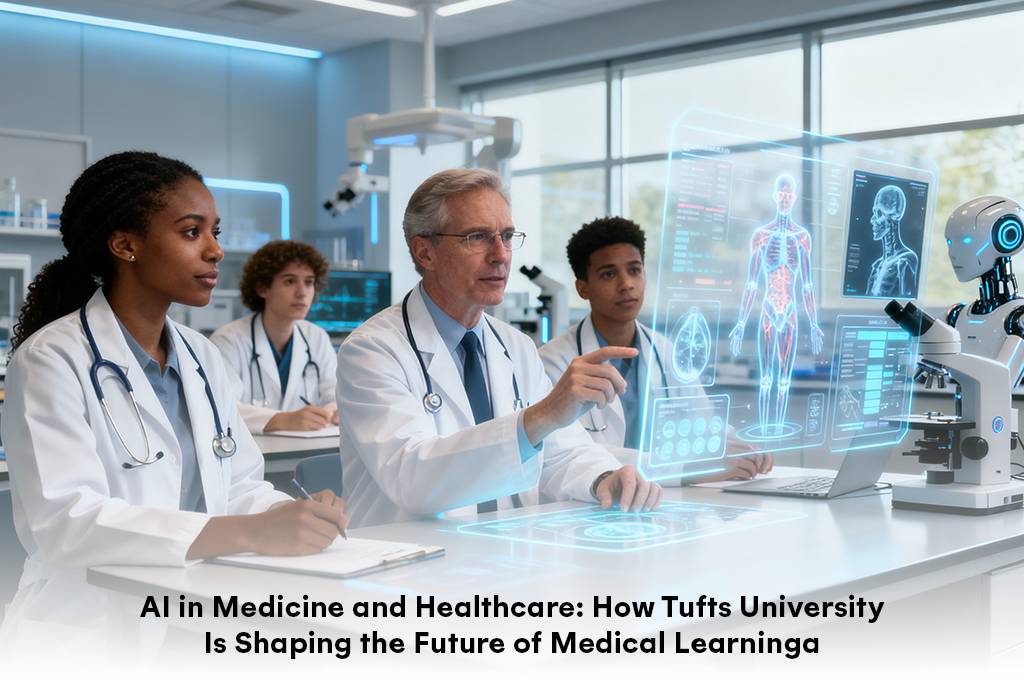
A group of School of Medicine professors and students took the pulse of their community to draft a roadmap for integrating the rapidly changing technology into the school’s curriculum. Their findings highlight why AI in medicine and healthcare is now a top institutional priority.
AI in Medicine and Healthcare
AI is rapidly transforming the healthcare sector, from medical education to clinical practice. At Tufts University School of Medicine, a recent survey found that two-thirds of doctors acknowledge the benefits of artificial intelligence in their work, yet only about one-third reported actually using it.
This gap points to a critical moment: healthcare professionals are recognizing AI’s potential, but many lack the training or confidence to deploy it. The survey among Tufts faculty and students reveals both enthusiasm and caution, signaling that the integration of AI in medicine and healthcare is advancing, but still in its early phase.
With increasing institutional focus on AI literacy and ethics, the healthcare industry is preparing for a shift where AI becomes embedded in everyday workflows, from diagnostics to treatment planning. According to the World Health Organization, digital health technologies including AI are increasingly central to improving health outcomes worldwide.
How Is AI Used in Medicine and Healthcare

At Tufts, faculty are already experimenting with large language models and generative AI tools for a variety of educational purposes: creating study materials, assisting students, drafting exam questions, and supporting clinical skills exercises.
For example, students used a chatbot to practice medical interviewing, and a neuroscience course integrated AI-powered tools to assist case study learning. These practical applications of AI in medicine and healthcare education are showing promise, helping students build clinical reasoning skills in a low-stakes environment.
However, faculty emphasize that AI output should not replace human oversight. One professor noted, “These technologies simulate knowledge generation and clinical reasoning with human-like fluency, this can be deceiving.” This underscores the importance of responsible AI use and critical evaluation skills for future medical professionals. Research published by the New England Journal of Medicine has similarly highlighted both the promise and the risks of AI tools in clinical settings.
What Is the Future of AI in Medicine
Looking ahead, the future of AI in medicine might include fully integrated decision-support systems, personalized treatment planning, real-time diagnostics, and even autonomous agents assisting in surgeries or remote care.
Tufts’ roadmap for integrating AI into its curriculum acknowledges that the technology is advancing faster than current educational frameworks. To close this gap, Tufts is developing new courses, faculty training programs, and ethical AI guidelines specifically tailored for medical education.
The role of AI will also expand in global health equity. Predictive analytics and AI-driven diagnostics can help under-resourced clinics make faster, more accurate decisions — improving access to care in regions where specialist physicians are scarce. The National Institutes of Health has documented multiple studies showing AI’s growing impact on diagnostic accuracy and patient outcomes.
When Was AI First Used in Medicine
AI’s roots in medicine date back several decades, but in recent years the capabilities have accelerated. The early uses of AI in medicine involved simple rule-based diagnostic systems and image-analysis tools. In the 2010s, machine-learning models began to appear in oncology and radiology.
Today’s AI systems leverage large language models and deep learning to tackle much more complex tasks, yet the survey at Tufts reminds us that the human dimension remains critical: doctors and students alike are calling for hands-on workshops and better understanding of AI’s limitations.
Bottom Line
AI in medicine and healthcare is no longer a futuristic concept — it’s being used now in education, clinics, and research. Tufts University School of Medicine is leading the way by developing a thoughtful, ethics-driven framework for integrating these tools into medical training. Still, the road ahead requires balancing innovation with ethics, training, and human-centred care.
Want to stay ahead in AI and medical innovation? Visit our homepage.