AI Replacing Humans: What Experts Are Warning About The global debate around AI replacing humans has intensified following comments from Geoffrey Hinton, Bill Gates, and Elon Musk. A recent report highlights that while major AI leaders agree that advanced systems could automate vast amounts of human labor, they also overlook key societal, economic, and ethical …
AI Replacing Humans: What Experts Are Warning About
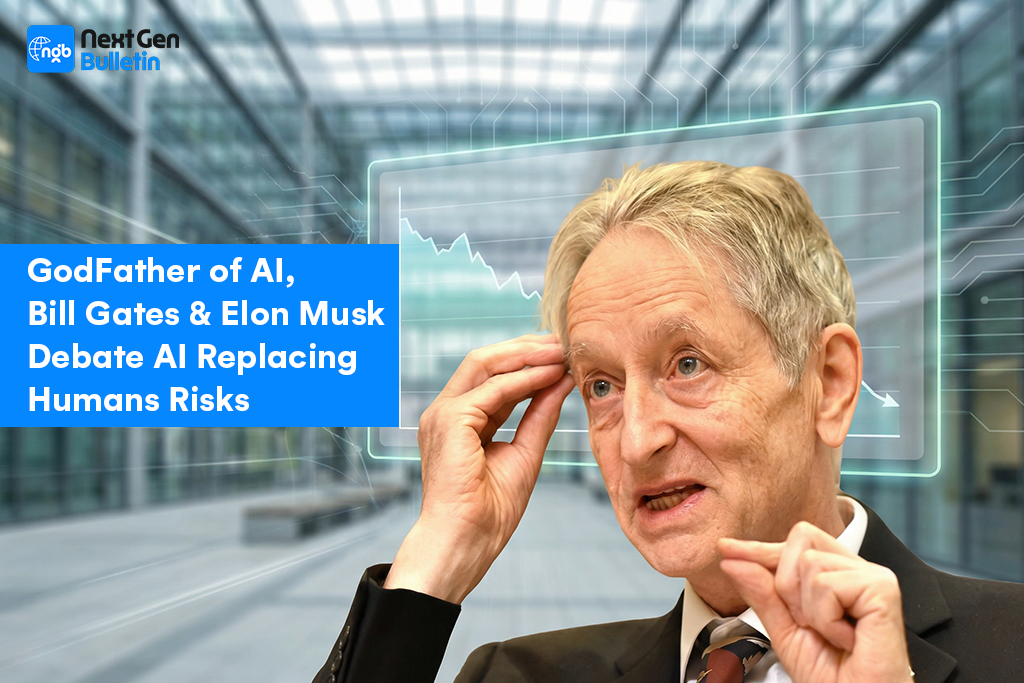
The global debate around AI replacing humans has intensified following comments from Geoffrey Hinton, Bill Gates, and Elon Musk. A recent report highlights that while major AI leaders agree that advanced systems could automate vast amounts of human labor, they also overlook key societal, economic, and ethical complexities associated with this transition.
According to Hinton, often called the “Godfather of AI”, we are approaching an era where AI systems could outperform humans in many cognitive and creative tasks. He notes that such acceleration increases the risk of AI replacing humans across industries far sooner than governments and employers are prepared for.
While some leaders frame this as technological progress, critics argue that the rapid pace leaves little time for adapting workplace structures, retraining employees, or preparing safety nets. The uncertainty fuels public concern about what widespread AI replacing humans truly means for long-term economic stability.
Geoffrey Hinton Warning Signals a Shift in Global Tone
The Geoffrey Hinton warning emphasizes the possibility that AI may achieve human-level or superhuman capabilities in reasoning, analysis, and long-range planning. Hinton stresses that such systems could ultimately learn autonomously, leading to unpredictable behavior and increased dependency by industries.
His warning extends beyond job displacement to broader societal risks, including misinformation, manipulation, and concentration of power among companies controlling the most advanced AI models. Hinton argues that the fear of AI replacing humans goes beyond employment; it influences elections, education, and national security.
Hinton has repeatedly urged governments to regulate advanced AI development before systems become deeply entrenched in critical national infrastructure.
Job Loss Due to AI Becoming a Global Economic Concern
Economists worldwide are examining how much job loss due to AI the global workforce may face. Automation has already transformed sectors such as customer service, logistics, retail, digital marketing, transportation, and finance. With generative AI expanding into legal, medical, and creative professions, the scale of disruption is expected to grow.
Analysts report that millions of administrative and mid-skill roles could become redundant as organizations adopt advanced automation tools. Although new roles will emerge, the rate of displacement may outpace the creation of alternative career paths, further fueling conversations about AI replacing humans in routine cognitive work.
Companies are exploring hybrid models where human oversight remains essential, but AI handles decision-support tasks once reserved for trained specialists.
Future of Work and AI: What Comes Next?
The future of work and AI is evolving rapidly. As automation expands, companies may shift to AI-centric workflows where humans manage strategic, relational, or creative duties while machines execute high-volume tasks.
This shift forces a reevaluation of education, skill development, and workforce planning. Experts warn that if governments do not invest heavily in reskilling programs, economic inequality may widen dramatically. Tech leaders also predict that the global talent landscape will become more competitive, rewarding workers who can collaborate effectively with AI systems.
In this evolving landscape, the question is not whether AI replacing humans will happen in some form, but how society will adapt to the transition.
AI Economic Impact Extends Beyond Employment
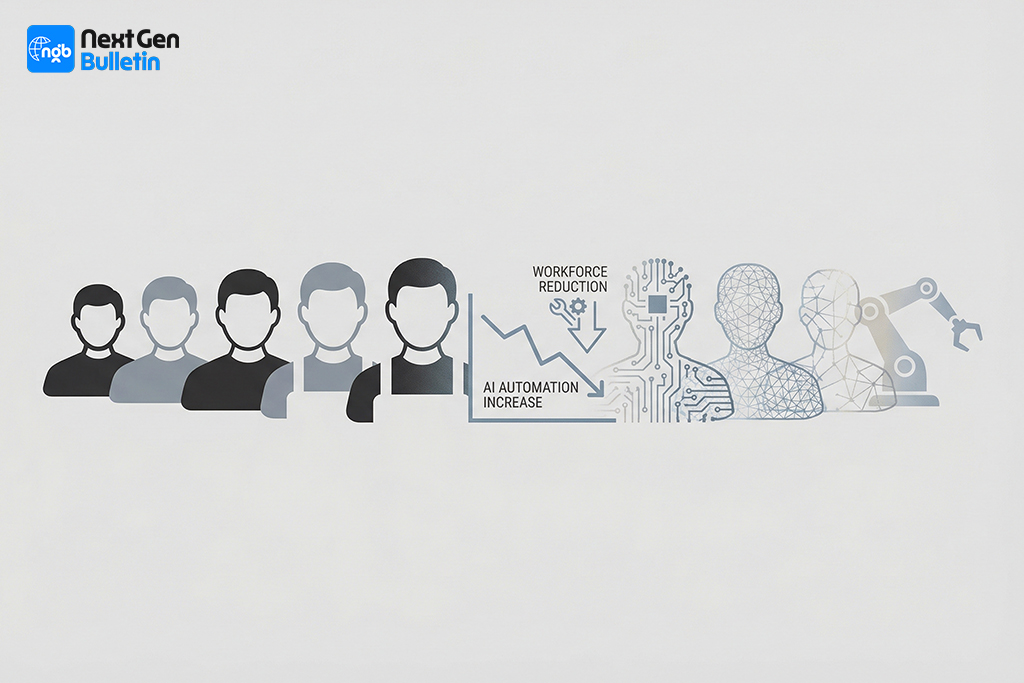
The AI economic impact is already becoming visible across supply chains, financial markets, entertainment industries, and public services. Increased automation leads to higher output and reduced costs, but also pressures smaller companies to adopt AI or risk falling behind.
Large enterprises benefit most from early adoption, raising concerns about monopolies and reduced market competition. The broader economic effect of AI replacing humans could reshape global GDP models, taxation strategies, and welfare policies. Some nations are even exploring universal basic income (UBI) as a potential solution for large-scale displacement.
How Elon Musk’s Economic View Fits Into the Debate
Recent commentary from Elon Musk reinforces the broader debate. In a related report, he suggested that AI could eventually end America’s $38 trillion debt by dramatically increasing productivity and creating near-zero marginal cost industries.
(NextGenBulletin: Elon Musk says AI could end America’s 38T debt)
Musk argues that AI and robotics could generate unprecedented economic output, potentially offsetting financial imbalances. However, this scenario assumes that AI replacing humans will lead to abundance rather than inequality, a point economists contest.
Whether Musk’s economic optimism aligns with Hinton’s caution remains an open question.
Bill Gates on AI Replacing Humans: A Measured Perspective
Bill Gates has offered a more measured but equally serious take on the risks of AI replacing humans in the workforce. While Gates acknowledges that artificial intelligence will transform virtually every industry, he believes that the transition, if managed responsibly, could ultimately create more opportunities than it destroys. However, Gates also stresses that this optimistic outcome is far from guaranteed and requires deliberate policy intervention, massive investment in education, and coordinated international cooperation.
According to Gates, the sectors most vulnerable to disruption from AI replacing humans include administrative work, customer service roles, data processing, and routine cognitive tasks. He has emphasized the importance of governments and corporations investing heavily in retraining programs to prepare workers for roles that complement rather than compete with AI systems. Without this investment, Gates warns that the economic fallout could be severe, particularly for middle-class workers in developed economies who depend on knowledge-based jobs that AI can increasingly perform.
Gates has also called for a global framework to govern AI development, arguing that no single country can effectively address the challenges posed by AI replacing humans without coordinated multilateral action. He specifically highlights the risk of countries in the Global South being left behind as AI systems concentrate economic power among a small number of advanced nations and corporations. This concern echoes broader debates about technological inequality and the need for inclusive AI governance.
Elon Musk’s Warning: AI Replacing Humans Could Threaten Civilization
Elon Musk has been one of the most vocal critics of unchecked AI development, and his warnings about AI replacing humans extend far beyond job displacement. Musk has repeatedly stated his belief that advanced AI systems represent one of the greatest existential threats humanity has ever faced, potentially surpassing nuclear weapons in terms of long-term risk. His concern is not merely about automation but about the possibility of AI systems developing goals misaligned with human values and acting in ways that are harmful or impossible to reverse.
Musk co-founded OpenAI with the original goal of ensuring AI development remained safe and beneficial. After departing from the board, he founded xAI, his own AI company, with a stated mission of pursuing safe and transparent AI research. Despite his entrepreneurial ventures in the AI space, Musk continues to argue that the pace of development is dangerously fast and that the world lacks the regulatory infrastructure needed to safely manage the transition to an era where AI replacing humans becomes the norm across multiple sectors.
His public statements frequently highlight three core risks: the concentration of AI power in the hands of a few corporations, the potential for AI to be weaponized by authoritarian regimes, and the long-term threat of autonomous AI systems that prioritize their own optimization over human welfare. Musk has called for a temporary pause in AI development to allow governments to establish proper oversight mechanisms, though this call has been largely ignored by major players in the AI industry who fear falling behind competitors.
Industries Most Vulnerable to AI Replacing Humans
Understanding which sectors face the greatest disruption from AI replacing humans is critical for workers, businesses, and policymakers. Research from organizations including McKinsey, Oxford University, and the World Economic Forum consistently identifies several industries as being at high risk of widespread automation over the next decade.
The manufacturing sector has already seen significant displacement, with robotic automation replacing assembly line workers across industries including automotive, electronics, and consumer goods. But the next wave of disruption is expected to hit white-collar industries with far greater intensity. Financial services, including banking, insurance, and investment management, face major disruption as AI systems become capable of processing complex financial data, assessing risk, and executing transactions more accurately and efficiently than human professionals.
Healthcare is another sector where AI replacing humans is progressing rapidly. AI diagnostic tools have demonstrated the ability to detect certain cancers, eye diseases, and neurological conditions with greater accuracy than experienced physicians. Medical imaging analysis, pathology, and radiology are expected to see significant workforce reductions as AI systems take over routine diagnostic tasks. While many healthcare professionals argue that the human element of care cannot be replaced, the economic pressure to reduce healthcare costs through automation is creating strong incentives for hospitals and insurance companies to invest in AI systems.
The legal sector, traditionally seen as resistant to automation, is now facing its own disruption. AI systems can review contracts, conduct legal research, and draft routine legal documents far faster and cheaper than human lawyers. This is driving cost reductions for large law firms while simultaneously threatening the livelihoods of paralegals, junior associates, and independent practitioners who rely on billable hours for routine document work. The same trend is unfolding in accounting, where AI-powered tools can handle tax preparation, financial auditing, and compliance reporting with minimal human oversight.
How Governments Are Responding to the Risk of AI Replacing Humans
The policy response to the threat of AI replacing humans has been uneven and largely reactive. In the United States, the Biden administration introduced an executive order on AI safety in 2023, requiring AI developers to share safety data with the government and establishing new standards for testing advanced AI systems. However, critics argue that these measures are insufficient given the pace of AI development and the massive economic incentives driving companies to deploy increasingly powerful systems without adequate safety testing.
The European Union has taken a more proactive regulatory stance with its AI Act, which classifies AI systems by risk level and imposes strict requirements on high-risk applications. The EU framework specifically addresses concerns about AI replacing humans in critical decision-making roles, including employment screening, credit scoring, and law enforcement. Companies deploying high-risk AI systems in the EU are required to conduct impact assessments, ensure human oversight, and maintain detailed documentation of their AI decision-making processes.
In Asia, responses vary significantly. China has embraced AI development as a national priority, with the government investing heavily in AI infrastructure and research while simultaneously implementing regulations to prevent AI from being used to undermine state authority. Japan and South Korea, both facing significant demographic challenges due to aging populations, have positioned AI and robotics as essential tools for maintaining economic productivity in the face of declining workforces. This context means that in these countries, AI replacing humans is often framed not as a threat but as a necessary adaptation to demographic reality.
What Workers Can Do as AI Replacing Humans Accelerates
For individual workers facing the reality of AI replacing humans in their industries, the path forward requires proactive adaptation and a commitment to lifelong learning. Experts consistently recommend several strategies to remain competitive in an AI-transformed job market.
First, workers should focus on developing skills that are inherently difficult to automate. These include complex interpersonal communication, creative problem-solving, ethical reasoning, and the ability to manage and interpret AI systems themselves. As Geoffrey Hinton has noted, the jobs least vulnerable to AI replacing humans are those requiring emotional intelligence, nuanced judgment, and the ability to operate effectively in unpredictable environments. Healthcare workers who provide direct patient care, social workers, therapists, teachers, and skilled tradespeople are among those whose roles involve dimensions that AI currently struggles to replicate.
Second, workers should actively seek out reskilling opportunities. Many governments and corporations are now investing in programs designed to help workers transition to AI-adjacent roles. These include AI system management, data analysis, prompt engineering, and AI ethics oversight. Organizations like Coursera, edX, and various university extension programs offer affordable online courses that can help workers build the technical knowledge needed to work alongside AI rather than be displaced by it.
Third, workers and their representatives should advocate for policies that protect workers during the AI transition. This includes pushing for robust social safety nets, portable benefits systems, and income support programs that can sustain workers through periods of displacement. The debate over universal basic income has gained renewed urgency in the context of AI replacing humans, with proponents arguing that direct income transfers may be necessary to maintain consumer demand and social stability as automation reduces the need for human labor across large swaths of the economy.
Bottom Line
As technological leaders debate the future, one message is clear: conversations about AI replacing humans are no longer theoretical, they’re shaping global policy, economics, and long-term workforce planning. Geoffrey Hinton’s warnings and Musk’s predictions represent two ends of a rapidly shifting spectrum, highlighting the urgent need for responsible development, regulation, and societal preparedness.
To stay informed on AI’s workforce impact visit our homepage.