Google AI Glasses Features Google has announced its first pair of smart eyewear sets to arrive in 2026, featuring built-in AI capabilities and integration with its Gemini model. The new Google AI glasses features will include hands-free voice and visual assistance, real-time translation, navigation overlays, on-the-go image recognition, and context-aware information delivery. According to announcements, …
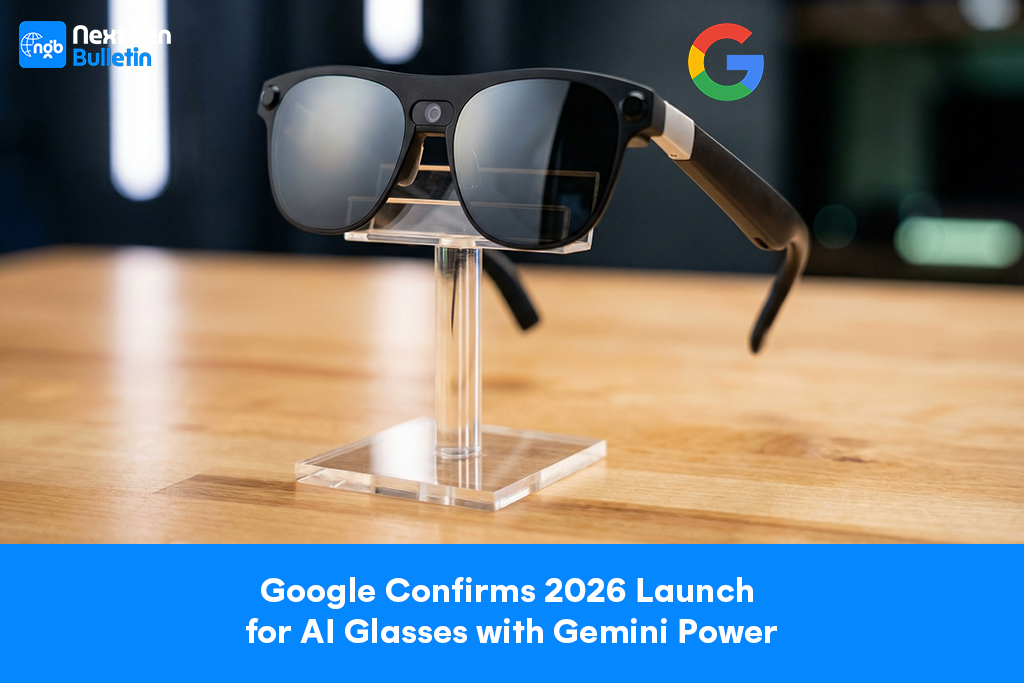
Google AI Glasses Features
Google has announced its first pair of smart eyewear sets to arrive in 2026, featuring built-in AI capabilities and integration with its Gemini model. The new Google AI glasses features will include hands-free voice and visual assistance, real-time translation, navigation overlays, on-the-go image recognition, and context-aware information delivery.
According to announcements, some variants will be “audio-only”, allowing interaction with Google AI without a visual display, while others will include an in-lens display, offering private HUD-style visuals like maps, captions, or short notifications.
The goal is to turn glasses into a subtle, everyday AI assistant: for example, translating foreign language signage in real time, overlaying directions while walking, lens-based voice commands, live captions, quick photo/video capture, and information lookup, all without pulling out a phone.
Android XR Smart Glasses Launch 2026
The new glasses will run on the Android XR ecosystem, providing a unified platform across display and audio-only modes. Google’s move signals renewed commitment to wearable XR hardware following past attempts like Google Glass.
Partnering with hardware manufacturers such as Samsung, Warby Parker, and Gentle Monster, Google aims to deliver several device SKUs in 2026, balancing form factor, functionality, and price.
Some prototypes already show promising performance: early Android XR tests with Gemini AI suggest smooth interaction, quick responses, efficient battery usage (better than some VR headsets), and seamless switching between voice, camera, and display modes.
Google Gemini AI Glasses Specs
Details on Google Gemini AI glasses specs remain limited, but leak-insider reports and prototype reviews hint at the following:
- A lightweight frame design, with optional in-lens microdisplay for HUD-like visuals.
- Built-in cameras and sensors for vision-based AI tasks such as real-time translation, OCR (text recognition), object identification, and augmented information overlays.
- Integration with Android ecosystem, allowing existing Android apps, Google services, and Gemini features to work out of the box.
- Real-time voice and gesture inputs (for display-optional models), allowing hands-free commands.
- Battery and performance optimizations aimed at all-day wearability (though detailed specs are yet to be disclosed).
Overall, Google’s aim seems to be a seamless AI assistant experience, balancing hardware portability, utility, and AI power.

Google Smart Glasses Price and Release Date
Google has confirmed the release window for its smart glasses: 2026.
While the company has not officially announced pricing, market analysts expect pricing to be competitive with current-generation devices, potentially in the $300–$600 range for audio-only models, and $500–$800 for display-enabled versions, depending on features.
This pricing range would strategically position Google to compete with existing products like the Ray-Ban Meta glasses (and their successors), which are priced around $799.
Given Google’s history with wearables and its intent to reach mainstream adoption, a moderate price point is likely aimed at maximizing user base rather than premium niche consumers.
Google AI Glasses vs Meta Ray-Ban
As Google moves into wearable AI eyewear, it enters an increasingly competitive landscape dominated by Meta’s Ray-Ban glasses. This sets up a head-to-head battle: Google AI glasses vs Meta Ray-Ban.
What Google brings to the table:
- Deep integration with Gemini AI and Google services (Maps, Translate, Search, Assistant).
- Open Android XR ecosystem, allowing broader app compatibility.
- Multiple form-factors: both audio-only and display-equipped versions (giving flexibility).
- Potentially lighter, more discreet design compared to traditional XR headsets.
What Ray-Ban Meta currently offers:
- Existing market presence and brand recognition.
- Functional hardware with camera, speakers, and AI assistance, already in the hands of users.
- Decent pricing and known features; but limited display capability and more restricted ecosystem.
Industry analysts expect Google’s glasses to challenge Ray-Ban’s dominance, especially if Google delivers competitive specs, reliable AI functionality, and a polished user experience under Android XR.
What to Watch
As 2026 approaches, several variables will determine if Google’s glasses become mainstream:
- Final hardware design and build quality must balance style and durability.
- Battery life and comfort, especially for daily wear in both display and audio-only variants.
- Software polish, ensuring Gemini interactions, app compatibility, privacy controls and latency match or exceed user expectations.
- Price point, affordable enough to attract mass-market users yet viable for Google’s hardware partnership model.
- Regulatory and privacy concerns, particularly with cameras and AI-based real-time image analysis in public spaces.
Success will depend not just on technology, but on ecosystem, trust, and real users needs a high bar, but Google seems committed.
Bottom Line
With Google AI glasses slated for a 2026 debut featuring rich AI glasses features, Gemini-powered smarts, and flexible hardware options, the company is poised to reenter the XR wearables race in a big way. Whether they dethrone Meta Ray-Ban or simply expand the smart-glasses audience remains to be seen, but one thing is clear: AI smart eyewear is becoming real.
Stay updated on XR, wearables, and AI device launches by visiting our homepage.
How Do AI Glasses Work with Gemini?
The AI glasses integrate directly with Google’s Gemini AI model, processing real-world data through built-in cameras, microphones, and sensors. When you look at an object, the camera captures the scene and sends it to Gemini for analysis in real-time. The AI then responds via audio through built-in speakers or displays relevant text or visuals through the optional in-lens display. This creates a seamless, hands-free experience that feels natural rather than intrusive.
Gemini’s multimodal capabilities are central to what makes the AI glasses powerful. Unlike earlier smart glasses that relied on simple voice assistants, these new AI glasses can understand context from images, voice, and text simultaneously. For example, you can glance at a restaurant menu and ask “What’s a good option for a vegetarian?” and Gemini will read and analyze the menu in real-time to provide a relevant recommendation.
Privacy and Safety Considerations for AI Smart Glasses
One of the most discussed aspects of AI glasses is privacy. The fact that these devices can continuously capture images, video, and audio raises important questions about consent and data security. Google has stated that its AI glasses will include indicator lights to signal when cameras or microphones are active, similar to how the original Google Glass handled the concern.
Users will be able to control data retention settings, with options to prevent recordings from being stored in the cloud. Privacy-conscious consumers will appreciate that Google is building these safeguards into the AI glasses from the start, rather than treating them as an afterthought. Local processing for certain tasks may also reduce reliance on cloud connectivity for sensitive data.
Frequently Asked Questions About AI Glasses
When will Google AI Glasses be available to buy?
Google has confirmed that the AI glasses will launch in 2026. While an exact date has not been announced, industry insiders expect the initial release to happen in mid-to-late 2026, with broader availability following shortly after. Early access may be offered through Google’s own store and select retail partners including Samsung and other Android ecosystem partners.
Do Google AI Glasses require a data plan?
Yes, Google AI glasses will require an active internet connection for most advanced features, including Gemini AI processing, real-time translation, and navigation. The glasses are expected to connect via your smartphone’s data plan through Bluetooth and Wi-Fi tethering, similar to how other wearables like smartwatches operate. Some basic functions may work offline, but the full AI experience requires connectivity.
Are Google AI Glasses compatible with prescription lenses?
Google has indicated that the AI glasses will be available in configurations compatible with prescription lenses. Working with hardware partners like Warby Parker — a company known for its prescription eyewear — suggests that prescription compatibility is a key goal. Users who require corrective lenses will not need to choose between vision correction and smart functionality. Display-model glasses will likely have more design constraints, but audio-only models should offer broad prescription compatibility.
How long does the battery last on AI smart glasses?
Battery life is one of the most critical factors for wearable adoption, and Google is aware of this challenge. Based on available prototype data and testing of Android XR-powered devices, the AI glasses are expected to offer several hours of active use. Audio-only variants, without a display to power, should achieve longer battery life compared to display-enabled models. Google aims to make the glasses last through a typical workday, with the expectation that users will charge them overnight.
The Future of AI Glasses Technology
Looking beyond the 2026 launch, Google’s AI glasses represent just the beginning of a broader transformation in how we interact with technology. As AI models like Gemini become more capable and wearable hardware continues to miniaturize, future generations of AI glasses could become as commonplace as smartphones are today. The vision is a world where your glasses serve as a constant, intelligent companion, helping you navigate daily tasks, communicate across language barriers, and access information without ever reaching for a device.
Google’s investment in the Android XR platform, combined with its ecosystem of apps, services, and hardware partners, positions it uniquely to lead this category. The 2026 AI glasses launch is not just a product release — it’s a statement of intent that smart eyewear is a core priority for Google. Whether consumers are ready to embrace AI-powered eyewear remains the biggest open question, but the technology itself has never been more mature or promising.
As competitors like Meta, Apple, and Samsung accelerate their own AI glasses roadmaps, the race to define the next computing platform has officially begun. Google’s deep experience in AI, search, and ecosystem integration gives it a formidable advantage. The 2026 AI glasses are expected to be just the first step in what could become Google’s most significant hardware category in a decade, fundamentally changing the way millions of people engage with information and the world around them every single day.