Meta Internal Friction During AI Arms Expansion Meta Platforms is grappling with intensifying Meta internal friction as it accelerates its AI ambitions, particularly around its newly formed Superintelligence Labs and the secretive TBD Lab. Meta internal friction has become increasingly visible as elite AI researchers brought in to push frontier AI are clashing with the …

Meta Internal Friction During AI Arms Expansion
Meta Platforms is grappling with intensifying Meta internal friction as it accelerates its AI ambitions, particularly around its newly formed Superintelligence Labs and the secretive TBD Lab. Meta internal friction has become increasingly visible as elite AI researchers brought in to push frontier AI are clashing with the company’s long-standing corporate culture and legacy executives, a dysfunction that threatens morale and productivity.
New hires from rivals such as OpenAI and Google, drawn by lucrative compensation packages, have run up against Meta’s bureaucratic processes and hierarchical decision-making, leading to operational slowdowns and discontent. The pressure cooker environment has become one of the most visible examples of struggles across big tech as the AI division struggles to balance innovation with corporate stability, further magnifying Meta internal friction.
TBD Lab Conflict: Elite Hires vs Bureaucracy
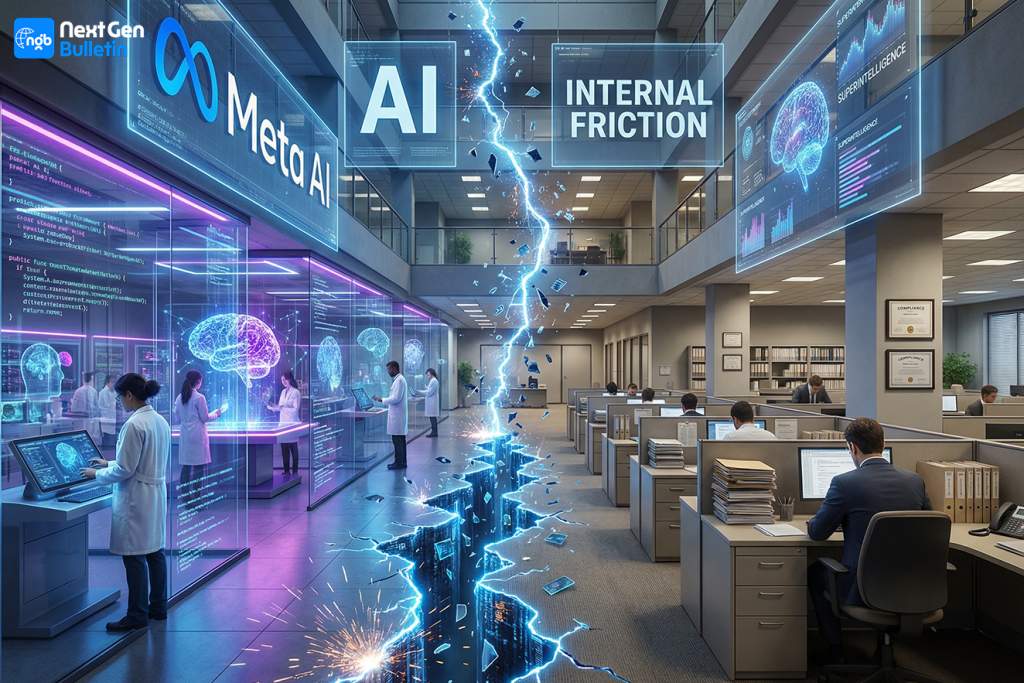
At the center of the current TBD Lab conflict are top-tier AI researchers recruited by Meta CEO Mark Zuckerberg to lead what he calls an effort toward “superintelligence.” Reports describe the team as elite but at odds with executives who oversee Meta’s social platforms and advertising products. The resulting friction has been described by some insiders as a cultural collision between fast-moving AI experts and the more traditional corporate hierarchy, adding more layers to Meta internal friction.
The TBD Lab, whose name stands for “To Be Determined” was created as part of a Superintelligence Labs initiative to give a dedicated core of researchers the freedom and resources to pursue next-generation AI models without typical bureaucratic oversight. However, the very autonomy meant to accelerate AI research has also sparked resentment among legacy teams and raised questions about how best to balance disruptive research with Meta’s business imperatives, contributing further to Meta internal friction.
AI Division Struggles Amid Superintelligence Push
Meta has restructured its AI division multiple times splitting Superintelligence Labs into four subunits focused respectively on research, infrastructure, productization, and foundational AI work. While this was intended to bring order and focus, the reorganization itself reflects deeper AI division struggles and ongoing Meta internal friction. Some veteran researchers have reportedly felt sidelined, while newcomers strive to adjust to a sprawling corporate environment that still manages legacy social products.
The company’s decision to cut about 600 roles from its AI teams excluding the elite TBD Lab, underscores the strategy to consolidate ambition around a smaller, higher-impact core. These layoffs affected established units like FAIR (Fundamental AI Research) and product AI teams, contributing further to tension between old guard researchers and the newly recruited superintelligence team—fueling Meta internal friction even more.
Superintelligence Labs Tensions and Talent Exodus
Tensions within the Superintelligence Labs are not just internal squabbles. Reports indicate that several top AI researchers have resigned within months of being hired, some returning to rivals such as OpenAI, highlighting how challenging it has been to retain talent amid shifting strategy and internal dynamics. These situations underscore the impact of Meta internal friction on talent retention efforts.
These departures illuminate how even deep pockets and ambition can struggle to sustain a coherent organizational culture when priorities and expectations diverge. Despite the prestige and potential breakthroughs on offer, some researchers have walked away, citing strategic differences or frustration with how resources and priorities are managed—yet another sign of Meta internal friction influencing team morale.
Meta AI Organizational Conflict: Root Causes
Industry analysts say Meta’s current Meta AI organizational conflict stems from a mix of strategic upheaval and managerial friction. Key contributors include:
- Aggressive hiring versus corporate culture: Meta’s strategy to lure top talent from competitors has resulted in a high concentration of “star” researchers used to lean structures, but now operating inside a large, hierarchical organization.
- Restructuring turbulence: Frequent reshuffles in the AI division have created uncertainty and identity loss among teams, compounding friction.
- Resource competition: Different AI units now compete for budget, compute, and visibility, pitting product-focused teams against foundational AI researchers.
- Legacy tech versus superintelligence vision: Some executives prioritize integrating AI into Meta’s social products, while others focus on theoretical breakthroughs that may lie years in the future, a classic case of Meta AI strategy disagreements.
Elite AI Hires vs Bureaucracy: A Culture Clash
The high-profile talent recruited, including founders, AI research leaders, and rising stars, brings expectations of startup-like agility, rapid experimentation, and academic freedom. However, Meta’s established bureaucratic mechanisms and layered approval processes have not always accommodated that mindset comfortably.
This clash between elite AI hires vs bureaucracy has manifested in meetings, conflicting priorities, and differing assessments of what constitutes success. Legacy executives, who helped build and scale Meta’s core products, sometimes view superintelligence aspirations as risky and misaligned with immediate business goals. Meanwhile, AI talent focused on cutting-edge research sees bureaucratic inertia as stifling.
Meta AI Strategy Disagreements Over Superintelligence
Part of the heated discourse is rooted in disagreements over how Meta should pursue “superintelligence”, defined as AI systems that surpass human capabilities across broad domains. Some leaders believe Meta should pursue proprietary models and tighten control over its AI stack, in contrast to its earlier open-source stance. Others advocate focusing on products that improve social platforms and drive revenue.
These Meta AI strategy disagreements reflect broader industry tensions between advancing foundational research and delivering commercial value in the short term. Decisions about resource allocation, research focus, and productization all carry significant implications for Meta’s future in an increasingly competitive AI landscape.
Bottom Line
Meta’s dramatic AI pivot has ignited Meta internal friction that goes beyond ordinary corporate growing pains. From the TBD Lab conflict to AI division struggles, Superintelligence Labs tensions, clashes between elite AI hires vs bureaucracy, and profound Meta AI organizational conflict, the company’s path toward advanced AI is shaping up to be as challenging internally as it is externally.For ongoing coverage of Meta’s AI strategy and industry shifts, visit our homepage.