What's Happening in the AI Call Center Space Will AI replace call centers? Artificial intelligence is reshaping how companies manage customer support. Call centers are shifting from repetitive, script-based operations to AI-powered communication hubs where humans and machines work together. As reported by the BBC, companies like eBay and NatWest are already using AI to …
What’s Happening in the AI Call Center Space
Will AI replace call centers? Artificial intelligence is reshaping how companies manage customer support. Call centers are shifting from repetitive, script-based operations to AI-powered communication hubs where humans and machines work together.
As reported by the BBC, companies like eBay and NatWest are already using AI to streamline customer interactions. eBay’s tools help agents find information and craft faster responses, while NatWest, through its collaboration with OpenAI, automates simple requests and supports staff with real-time insights for complex cases.
This transformation is also changing job dynamics. Some firms, including Sky and BT, have reduced call center roles as automation grows, but experts say AI is augmenting, not replacing, human agents, creating new opportunities for more skilled, oversight-driven roles.
According to McKinsey & Company, AI and automation could handle up to 30% of tasks currently performed by call center agents, but the human element remains irreplaceable for complex, emotionally sensitive interactions. This is why the real question isn’t simply will AI replace call centers — it’s how AI will transform them.
Volusia County’s AI Assistant
In Florida’s Volusia County, the sheriff’s department introduced an AI assistant named Ava for non-emergency 911 calls. Ava helps residents report issues like potholes, abandoned vehicles, or animal concerns, collecting information and routing urgent matters to live dispatchers instantly.
This system has eased pressure on human operators, ensuring emergency lines stay open for critical calls. It’s a small-scale but powerful example of how AI can support, not replace, human responders.
Will AI Replace Call Centers? : AI in Call Centers

AI systems today can listen, transcribe, and process calls in real time. They help identify caller intent, predict next steps, and route calls more intelligently. This makes customer interactions smoother and less time-consuming.
For instance, many companies now deploy chatbots and virtual agents for first-level support, allowing customers to check account details or reset passwords without human intervention. If the system detects confusion, emotion, or escalation, it transfers the call to a live agent equipped with all relevant context, saving time for both sides.
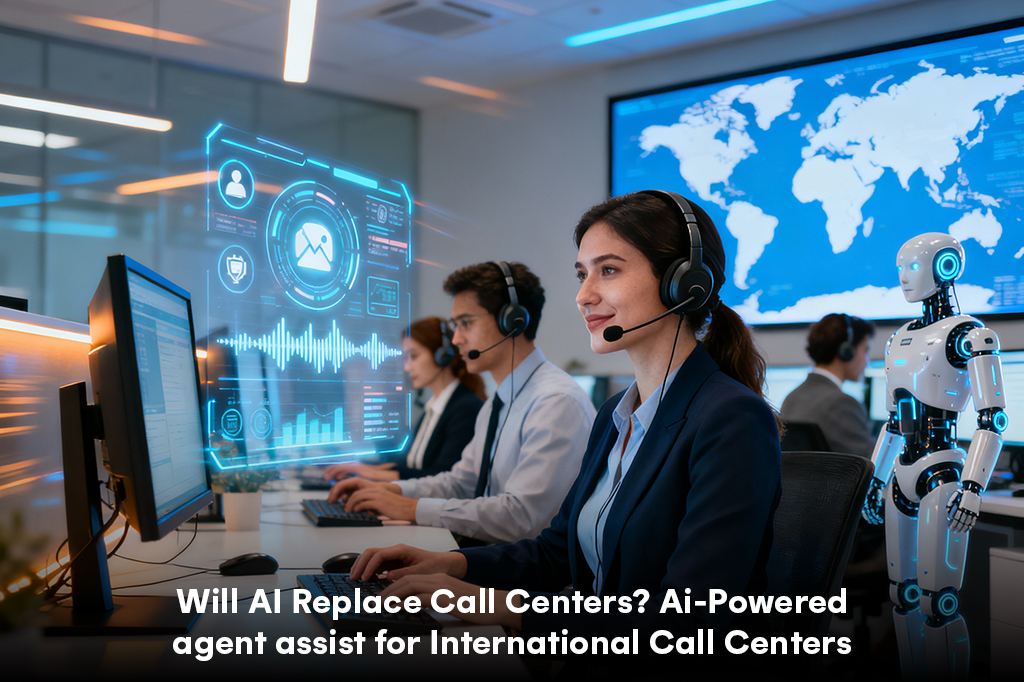
AI-Powered Agent Assist for International Call Centers
In global operations, AI-powered agent assist tools have become essential. These systems act as real-time copilots, suggesting phrases, surfacing policy details, translating languages, and monitoring tone during conversations.
Imagine an agent in the Philippines helping a caller in Germany. As they talk, the AI listens in, highlights key account information, and prompts the agent with compliant, localized responses. After the call, it auto-generates a post-call summary, reducing administrative work. This combination of speed, consistency, and personalization allows international call centers to maintain quality across time zones and languages.
Still, success depends on balance. The best systems use AI to empower, not overshadow, human agents. When implemented poorly, they can make agents sound scripted or robotic.
AI-Powered Call Centers: The Future of Lead Engagement
Beyond customer service, AI is transforming lead generation and sales engagement. Intelligent call systems can scan databases, initiate outbound calls, qualify leads, and personalize follow-ups automatically.
By analyzing speech and sentiment, AI can determine when a prospect seems interested or hesitant. It then passes the most promising leads to human agents for final conversion. This shift means companies can handle 24/7 outreach at scale, without compromising on quality.
The 5 Powerful AI Strategies Transforming Call Centers
For businesses asking will AI replace call centers, understanding these five core AI-powered strategies is essential for staying competitive:
- Real-Time Agent Assist: AI listens to live calls and instantly surfaces relevant knowledge base articles, scripts, and compliance notes, dramatically reducing handle time and errors.
- Intelligent Call Routing: AI analyzes caller intent, sentiment, and history to match customers with the best-suited agent or automated solution, improving first-call resolution rates.
- Automated Quality Assurance: AI monitors 100% of calls for compliance, tone, and performance metrics, replacing the need to manually review random samples.
- Multilingual Support & Translation: AI-powered real-time translation tools allow international call centers to support customers in dozens of languages without additional staffing costs.
- Predictive Customer Insights: AI analyzes historical interaction data to predict customer needs, enabling proactive outreach before issues escalate.
Will AI Replace Call Centers? The Statistics Tell a Clear Story
Will AI replace call centers entirely? Research from Gartner predicts that conversational AI will reduce contact center agent labor costs by $80 billion by 2026. However, this doesn’t signal mass replacement — it signals transformation. Agents freed from routine tasks can focus on high-value, complex customer problems that require human empathy and judgment.
IBM research highlights that AI-powered customer service tools can resolve up to 80% of routine customer queries without human involvement. This efficiency frees agents to handle the 20% of interactions that truly require human expertise — difficult complaints, sensitive situations, and relationship-building conversations.
So, will AI replace call centers? The honest answer is: not entirely. AI will replace the tasks, but not the teams. The most effective call centers in 2025 and beyond will be those that successfully integrate AI tools to enhance human performance rather than substitute it.
Key Impacts: Benefits and Challenges
The impact of AI on call centers is both economic and human.
- Efficiency gains: Reduced waiting times, faster resolutions, and better data management.
- Workforce evolution: Routine tasks fade, while roles requiring emotional intelligence and problem-solving grow.
- Cost restructuring: Companies can serve more customers with fewer agents.
- Ethical concerns: Continuous call monitoring and voice analysis raise privacy questions.
While AI won’t fully replace human agents, it’s redefining their purpose, shifting from task execution to relationship management. The future of customer engagement will likely be hybrid, where AI handles the routine and humans deliver the empathy.
How AI-Powered Call Centers Are Reducing Costs and Improving CSAT Scores
One of the most compelling arguments in the debate over whether will AI replace call centers is the measurable impact on both cost reduction and customer satisfaction (CSAT) scores. Organizations that have deployed AI-powered solutions are reporting significant improvements across the board.
A typical inbound call center handles thousands of interactions daily. With AI handling Tier 1 support — password resets, order status updates, billing inquiries — human agents are freed to focus on Tier 2 and Tier 3 calls that require empathy, problem-solving, and relationship management. This division of labor can reduce average handle time (AHT) by 20-30%, according to Forrester Research.
Furthermore, AI-powered agent assist tools improve first-call resolution (FCR) rates by ensuring agents always have the right information at their fingertips. When FCR improves, customers don’t need to call back, reducing overall volume and costs. Companies report that implementing AI-driven agent support can increase FCR rates by 10-20% within the first year of deployment.
Will AI Replace Call Centers in Emerging Markets?
In countries like India, the Philippines, and Kenya — which host millions of call center jobs — the question of will AI replace call centers carries enormous economic weight. These nations have built thriving business process outsourcing (BPO) industries that employ millions of workers and contribute significantly to their GDP.
The good news is that AI is not immediately displacing this workforce. Instead, it’s shifting the skillset requirements. Agents who previously handled simple transactional queries are now being trained to manage AI tools, oversee automated workflows, and handle complex escalations. Countries like the Philippines are actively investing in AI upskilling programs to ensure their call center workforce remains competitive in this new paradigm.
For international call centers operating across borders, AI-powered translation and cultural intelligence tools are becoming game-changers. These tools allow agents in one country to seamlessly serve customers in another, bridging language barriers and cultural nuances in real time. This capability dramatically expands the geographic reach of international call centers without proportionally increasing headcount.
Choosing the Right AI Tools for Your Call Center
For businesses looking to implement AI in their call center operations, the choice of tools matters enormously. The market offers a wide range of solutions, from standalone chatbots to comprehensive AI-powered contact center platforms. Key features to evaluate include:
Natural Language Processing (NLP) accuracy: The AI must understand customer intent correctly across different accents, dialects, and communication styles to be effective in international call centers.
Integration capabilities: The best AI solutions integrate seamlessly with existing CRM systems, ticketing platforms, and knowledge bases, ensuring agents can access all relevant customer information in one unified interface.
Scalability: As call volume fluctuates seasonally or during product launches, the AI infrastructure must scale up and down efficiently without service interruptions.
Compliance and security: For regulated industries like healthcare, finance, and telecommunications, AI tools must meet strict data privacy and compliance requirements (GDPR, HIPAA, PCI-DSS).
The answer to will AI replace call centers ultimately depends on how businesses choose to implement these technologies. Those that view AI as a tool for human empowerment will build stronger, more resilient customer service organizations. Those that try to use AI purely for cost-cutting through mass automation may find that customer satisfaction suffers as a result.
Final Takeaway
So, will AI replace call centers? Probably not entirely, but it’s changing their DNA. From AI-powered agent assist systems to intelligent lead engagement tools, artificial intelligence is making call centers faster, smarter, and more adaptive.
The next generation of customer service won’t be human or AI, it will be both. Companies that embrace this synergy will lead the way in creating efficient yet empathetic customer experiences worldwide.
Stay informed on how AI is transforming global call centers, from agent-assist tools to automation trends, by visiting our homepage.